


The Gaganyaan Equation: How ISROis Redefining the Math of Human Spaceflight :

India reached Mars on a shoestring budget. So why is sending astronauts into low Earth orbit demanding over a billion dollars and a decade of waiting? The answer reveals how the Indian space agency operates differently from every other global counterpart.
An agency famous for reaching the Red Planet on its maiden attempt, spending less than the cost of a Hollywood blockbuster, has spent the last decade building a capsule to go just 400 kilometres above Earth. The budget for this orbital leap is twenty times larger than the Mars mission.
For years, the global strategic community has wondered why the Indian Space Research Organisation (ISRO) seemingly abandoned its legendary frugality for the Gaganyaan programme. The reality is quite the opposite. The math of human survival in a vacuum simply demands a different kind of engineering. It requires a philosophy that separates ISRO’s methodical blueprint from the brute-force spending of every other space agency in the world.
If ISRO choked international competitors with its budget margins during the robotic exploration of the Moon and Mars, Gaganyaan proves that human spaceflight is an entirely different economic equation.
The Question Every Space Enthusiast Asks:
To understand the timeline, we must first discard the misconception that Gaganyaan began with a political announcement in 2018.
When NASA or Roscosmos decided to put humans in space during the Cold War, they possessed virtually unlimited defence budgets to build bespoke, monolithic rockets from scratch. ISRO enjoys no such luxury. Instead of designing an entirely new architecture for human spaceflight, the agency had to weave it into its existing civilian and commercial launch framework.
By the time the programme received formal Cabinet approval, ISRO had already spent years validating the foundational physics of atmospheric re-entry and capsule recovery
The Trajectory of Indian Human Spaceflight:
MILESTONE | DATE | SIGNIFICANCE |
Early Feasibility Studies | 2004 | Internal studies for human spaceflight initiated |
SRE-1 Mission | Jan 2007 | Demonstrated heat shield tech & capsule recovery |
CARE Mission | Dec 2014 | Tested Crew Module re-entry dynamics |
Pad Abort Test | Jul 2018 | Demonstrated Crew Escape System |
Cabinet Approval | Dec 2018 | Initial ₹9,023 crore allocated |
Astronaut Selection | 2019–2020 | Four IAF test pilots selected |
Russia Training | 2020–2021 | Generic spaceflight training at Star City |
TV-D1 Test | Oct 2023 | In-flight Crew Escape System demo |
Axiom-4 Mission | Mid 2025 | Indian astronaut aboard ISS for experiments |
G1 (Expected) | Late 2026 | First uncrewed orbital test flight |
Crewed Mission | 2027–2028 | First human launch into low Earth orbit |
The Numbers That Make Gaganyaan Look Different:
Indian robotic missions have historically leveraged modular, off-the-shelf components and highly optimized orbital profiles. The Mars Orbiter Mission (MOM) used a complex gravity-assist trajectory because the PSLV rocket lacked the raw thrust for a direct injection. It traded time for fuel and money. This approach completely disrupted the budgetary expectations of global competitors.
Human spaceflight allows for no such compromises. You cannot send astronauts on a multi-month, fuel-saving trajectory to low Earth orbit.
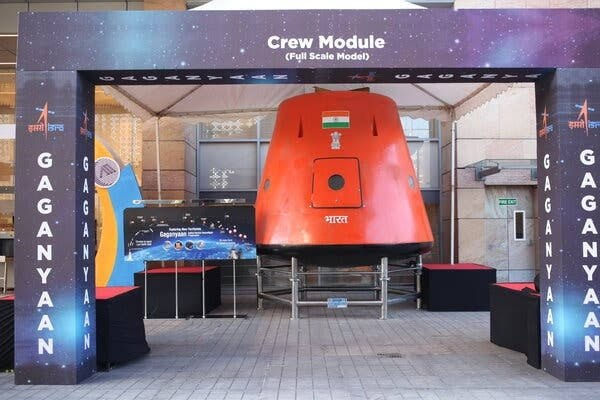
Comparing robotic mission budgets to Gaganyaan highlights the stark difference between collecting scientific data and keeping a human crew breathing. A failure in a robotic mission is a financial setback.
A failure in a human mission is a national tragedy. A poignant example is NASA's Mars Climate Orbiter in 1999. That probe disintegrated in the Martian atmosphere due to a software mismatch between metric and imperial units. That single mathematical error destroyed a $327 million project. If a similar miscalculation occurs on a crewed module, the cost is measured in human lives.
This fundamental difference in risk tolerance explains the financial chasm between Chandrayaan and Gaganyaan.
MISSION | AGENCY | LAUNCH | COST | OUTCOME |
Chandrayaan-I | ISRO | 2008 | ~$74M | Success |
LRO | NASA | 2009 | ~$504M | Success |
Mars Climate Orbiter | NASA | 1998 | ~$327M | Failed |
Mangalyaan (MOM) | ISRO | 2013 | ~$74M | Success |
Chandrayaan-3 | ISRO | 2023 | ~$75M | Success |
SLIM | JAXA | 2023 | ~$120M | Success |
Luna-25 | Roscosmos | 2023 | ~$130M+ | Failed (Crashed) |
Gaganyaan | ISRO | 2027/28 | ~$1.1B+ | In Development |
Note: Figures are approximate estimates. Mission scopes differ wildly, making direct comparisons useful but imperfect.
Why Humans Change Everything:
The ₹9,023 crore allocated to Gaganyaan does not merely fund a spacecraft. It funds a profound philosophical shift in how India engineers technology.
ISRO is currently retrofitting its workhorse heavy-lifter into the Human-Rated LVM3 (HLVM3). The launch vehicle now demands quadruple redundancy in its critical avionics. If a primary system fails, a secondary takes over. If the secondary fails, a tertiary system engages.
Then there is the Crew Escape System (CES). This intricate array of quick-acting solid rocket motors is designed to rip the Crew Module away from a failing launch vehicle in milliseconds. ISRO engineers spent years perfecting this mechanism, culminating in the flawless TV-D1 abort test in October 2023.6 It remains the most expensive piece of hardware on the rocket that everyone hopes will never ignite during an actual mission.

The Environmental Control and Life Support System (ECLSS) represents another monumental hurdle. Regulating cabin pressure, scrubbing carbon dioxide, and managing severe thermal loads in a vacuum requires an unforgiving level of precision. Rocket engines fire for a few minutes. Life support must operate flawlessly for days. Mastering this indigenous ECLSS has been the primary driver of the programme's extended timeline. ISRO cannot outsource the engineering of the air its astronauts will breathe.
The Russian Chapter:
While strategic autonomy remains the ultimate goal, pragmatism dictates international cooperation to mitigate risk and save time. In 2019, ISRO signed a contract with Glavkosmos, a subsidiary of the Russian state space corporation Roscosmos. This agreement facilitated the training of four Indian Air Force test pilots at the Yuri Gagarin Cosmonaut Training Centre in Star City.
The Russian chapter was a calculated exercise in risk reduction. The Indian crew underwent rigorous generic spaceflight training, winter survival courses, and acclimatisation to the physiological stresses of microgravity. Russia possesses decades of unbroken human spaceflight experience, making them an ideal partner for foundational training.
However, as the geopolitical landscape shifted following the Ukraine conflict, supply chain disruptions forced ISRO to accelerate the indigenisation of critical components like spacesuits and crew seats. Adapting and certifying these highly specialised alternatives locally added unavoidable time to the development schedule. Indian industry had to learn to manufacture materials that could withstand the unique acoustic and vibrational stresses of launch.

What Comes After Gaganyaan?
Gaganyaan is not a culmination. It is the establishment of a baseline capability. The government has laid out definitive follow-on objectives. The most prominent is the deployment of the Bharatiya Antariksh Station (BAS) by 2035, followed by placing an Indian on the Moon by 2040.
To prepare for these milestones, India has actively sought out parallel operational experience. In 2025, Group Captain Shubhanshu Shukla flew aboard the SpaceX Dragon spacecraft to the International Space Station as part of the Axiom-4 mission.7 During his time in orbit, he conducted microgravity experiments developed by Indian research institutions. This mission provided ISRO with invaluable modern data on long-duration spaceflight protocols and orbital operations.
To support these long-term ambitions, ISRO is currently developing the Next Generation Launch Vehicle (NGLV). This will be a partially reusable heavy-lifter designed to carry significantly heavier payloads than the current fleet. The first building block of this future architecture, the BAS-01 module, has already received Cabinet approval and is targeted for launch in 2028.
The Verdict of whole:
Has Gaganyaan taken too long? By the standards of Cold War space races, some might argue it has. But India is not racing anyone.
The delay and the expense are not signs of inefficiency. They are the strict price of admission to an exclusive club. Rushing a human into orbit using borrowed technology might yield a temporary geopolitical headline, but it does not yield strategic autonomy.
Gaganyaan is expensive because human life is fragile. It is taking time because ISRO is not just building a spacecraft. The agency is building the entire industrial, medical, and operational ecosystem required to sustain an independent Indian presence in space for the next fifty years.
When the HLVM3 finally clears the launch pad at Sriharikota, it will carry three astronauts. More importantly, it will carry the validated capability of the Indian aerospace industry to operate at the absolute limits of human engineering.
By Kashetty Sai Kiran, Editorial Director- Technology & AI Innovation DKBwBHAVYA
Comments